
Categories
Market UpdatePublished March 6, 2026
Industrial and Retail Trends Are Shaping the Phoenix Construction Market in 2026

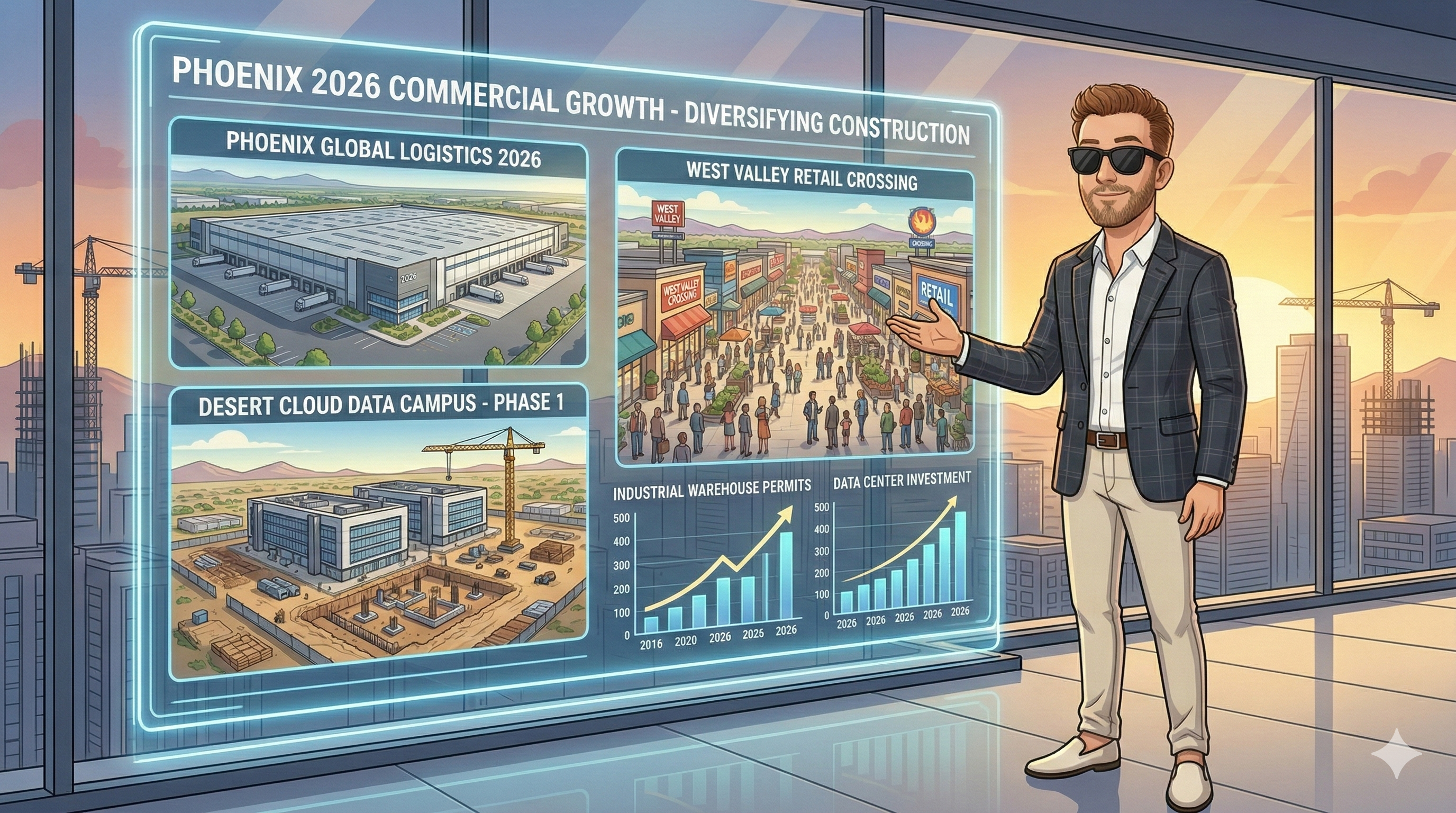
The Phoenix construction market continues to evolve as industrial and retail trends influence where developers are building, and how the commercial real estate landscape is changing. According to a recent report from LGE Design Build, these trends are helping redefine growth priorities and project strategies throughout the metro as we move deeper into 2026.
Understanding what’s driving this activity, and how it impacts commercial real estate, is crucial for investors, business owners, developers, and property stakeholders considering projects or property acquisitions in the Phoenix area.
Industrial Demand Remains Strong but Strategic
The industrial sector has been a cornerstone of Phoenix’s commercial real estate growth for several years. Recent trends show a measured shift from speculative construction to tenant‑driven development:
- Net absorption accelerated in late 2025 as leasing activity picked up, resulting in lower vacancy overall.
- Developers are increasingly focused on buildings tied to logistics, manufacturing, and technology users — rather than speculative starts.
This shift aligns with broader industrial performance trends seen in recent years. Phoenix has consistently been one of the nation’s leading industrial markets, thanks to strong demand for distribution space and supply chain infrastructure.
At the same time, construction deliveries are slowing compared with past peaks, meaning the market is balancing supply with actual demand — a potentially stabilizing development for rents and leasing activity.
Retail Development: Need‑Driven and Tight Fundamentals
While retail construction hasn’t matched industrial’s volume, the sector remains exceptionally tight and strategically important to the Phoenix commercial landscape:
- Retail construction continues at a measured pace, largely driven by actual tenant demand rather than speculative build‑outs.
- Growth is occurring in corridors with strong population increases or limited supply, including suburban and infill centers, where convenience retail and service‑oriented spaces thrive.
This trend reflects a broader evolution in retail property performance: even as some national markets show retail volatility, Phoenix’s fundamentals remain sound due to strong employment growth, population inflows, and local consumer demand.
Office Demand Showing Early Signs of Life
Another notable trend shaping Phoenix’s construction market is a renewed, albeit modest, resurgence in office activity:
- After years of subdued new office development, net absorption in late 2025 showed the strongest quarterly gains since 2019.
- Tenants are increasingly returning to Class‑A and Class‑B spaces, especially where buildings have been upgraded or repositioned.
While office construction is not yet booming, strong tenant engagement and planned repositioning projects signal growing confidence among occupiers — particularly in central business districts and high‑amenity submarkets.
Data Centers and Tech Infrastructure Are Reshaping Labor & Materials
One of the defining influences on Phoenix’s construction market in 2026 isn’t limited to traditional commercial sectors — it’s the expansion of data centers and AI‑driven infrastructure:
- Increased demand for advanced computing facilities is putting pressure on electricians, specialty trades, and long‑lead equipment across all construction sectors.
- Power availability and utility infrastructure timelines are emerging as key feasibility factors for large‑scale commercial and industrial projects.
This trend mirrors national patterns in tech‑related commercial builds, including semiconductor and data facility investments, which are drawing labor and materials away from other sectors while stimulating higher‑tech construction demand.
Construction Labor & Supply Chain Outlook
While project timing and labor remain challenging, Phoenix is seeing positive growth in construction employment:
- Construction jobs increased year‑over‑year, primarily in building and specialty trades.
- Supply chains have become more predictable, with fewer surprise disruptions thanks to stable logistics, rail usage, and clarified tariff expectations — though materials costs still vary across categories.
This more stable supply chain environment may help projects stay closer to projected timelines and budgets — a welcome change after recent years of volatility.
What This Means for Commercial Real Estate Investors & Developers
As industrial absorption improves and retail fundamentals remain tight, Phoenix’s construction market appears to be entering a strategic, demand‑driven phase:
- Industrial properties with strong tenant demand and logistics connectivity remain core drivers of growth.
- Retail corridors with real consumer demand continue to attract development interest.
- Emerging sectors like data centers and tech infrastructure are reshaping labor, materials, and project planning.
For investors and developers, this means focusing on quality assets in growth areas and anticipating how infrastructure and workforce dynamics impact project feasibility and timelines.
Phoenix’s construction market in 2026 is defined by targeted growth, resilient fundamentals, and evolving sector dynamics. Industrial demand remains strong but measured, retail development is driven by genuine tenant needs, and office space is showing signs of renewed interest. At the same time, the rise of data centers and AI infrastructure is reshaping labor and planning considerations across commercial sectors.
Whether you’re exploring commercial investment opportunities, planning new development, or looking for insights on how construction trends affect property values, this evolving market offers diverse pathways for strategic engagement.
|


or another way