
Categories
Moving to Phoenix?Published January 15, 2026
Existing-Home Sales Rose in December, but 2025 Still Finished Near Historic Lows


By Scott Bryant | Commentary on Realtor.com® Housing Data (Jan 14, 2026)
December 2025 existing-home sales posted a noticeable rebound, and that improvement matters here in Phoenix, where buyer activity tends to respond quickly when affordability conditions improve. Nationally, existing-home sales rose 5.1% in December, reaching a seasonally adjusted annual pace of 4.35 million homes, which came in 1.4% higher than December 2024 (4.29 million), according to Realtor.com®.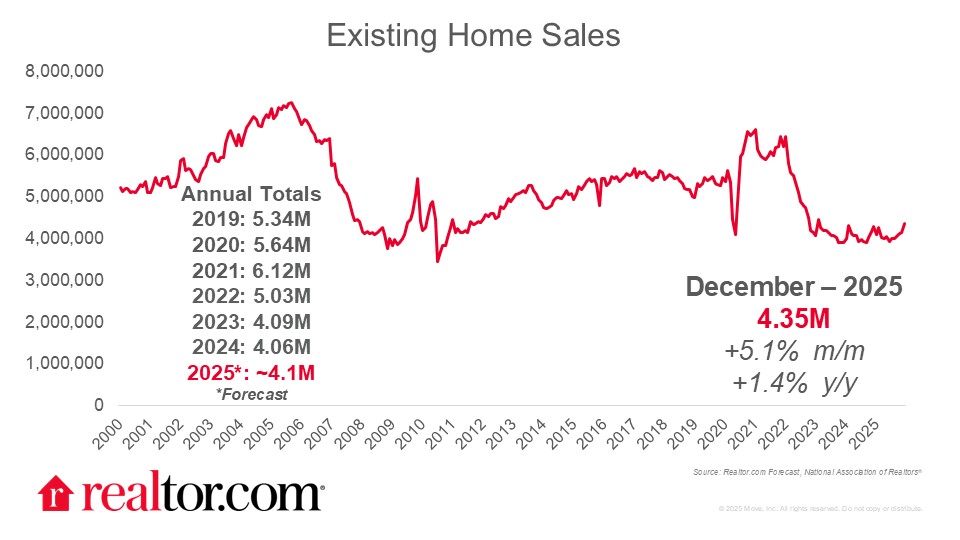
This uptick didn’t come out of nowhere. Pending home sales increased in November, both month-over-month and year-over-year, as lower mortgage rates improved purchasing power. That momentum carried into December and even resulted in a modest upward revision to November’s existing-home sales, now reported at 4.14 million instead of 4.13 million.
In Phoenix, I saw this play out in real time. As rates stabilized late in the fall, buyer inquiries increased, showings picked up, and well-priced homes began moving again, especially in desirable neighborhoods and price bands where affordability is most sensitive to rate changes.
2025 existing-home sales narrowly miss 2024 totals
Even with December’s improvement, total existing-home sales for 2025 finished just below 2024 levels. Nationwide, 4,061,000 homes sold in 2025, compared to 4,062,000 homes sold in 2024—a difference of only 1,000 sales.
That slim margin makes 2025 the lowest annual existing-home sales total since 1995. While the headline sounds dramatic, the reality is more nuanced. Demand never disappeared, it was constrained by mortgage rates, affordability pressures, and limited housing supply, all of which were factors Phoenix buyers felt acutely throughout much of the year.
Mortgage rates ease, helping Phoenix buyers regain footing
December buyers, many of whom went under contract in October and November—benefited from mortgage rates near their lowest levels of the past year. Encouragingly, rates have not climbed meaningfully since, helping restore some confidence among home shoppers.
Mortgage rates continue to face a mix of influences, from mortgage-backed securities (MBS) buying programs to broader economic forces like employment and inflation. So far, these pressures have largely offset each other, keeping rates steady to slightly lower.
For Phoenix buyers, even small shifts in mortgage rates can significantly impact monthly payments. That’s why I expect this rate environment to help stabilize existing-home sales in 2026, particularly in move-up and discretionary segments of the market.
Rising sales activity tightens housing supply
As sales improved in December, home prices continued to grow, even with some seasonal softening in asking prices. Nationally, the median existing-home sales price rose 0.4% year-over-year to $405,400.
At the same time, months’ supply tightened, dropping from 4.2 months in November to 3.3 months in December. While this decline is typical seasonally, it’s notable that months’ supply remains higher than December 2024, when it stood at 3.2 months.
What stood out most was the seasonally adjusted months’ supply, which fell back into seller’s market territory at 3.8 months. This reflects a familiar pattern: buyers responded faster than sellers when mortgage rates eased late in the year.
In Phoenix, this dynamic shows up as increased competition for well-presented homes, even while overall inventory remains elevated compared to pandemic-era lows.
Regional variation highlights Phoenix’s supply advantage
All four major regions posted month-over-month gains in existing-home sales. The South and West led the way, with increases of 6.9% and 6.6%, respectively, compared to 2% gains in the Northeast and Midwest.
Year-over-year, sales were flat in the Midwest and West, rose 3.6% in the South, and declined 1.9% in the Northeast. Price trends also diverged:
- Northeast: +3.7%
- Midwest: +3.1%
- South: -0.3%
- West: -1.4%
These patterns align with Realtor.com® findings that for-sale home inventories in the South and West, including Phoenix, are much closer to pre-pandemic norms, within 5% or better. In contrast, inventories in the Midwest and Northeast remain down by a third or more compared to pre-pandemic levels.
This relative inventory recovery is one reason Phoenix continues to experience more balanced conditions than many eastern markets, even as national headlines suggest ongoing supply challenges.
What this means for Phoenix homeowners and buyers
December’s rebound in existing-home sales reinforces what I’ve been saying locally: the market is responding, not collapsing. When affordability improves, even modestly, buyers re-engage. As we move further into 2026, mortgage rates, local inventory levels, and pricing strategy will matter more than ever.
National data provides the framework, but real estate is local, and Phoenix continues to operate on its own timeline within these broader trends.
Source: Realtor.com® Housing Data
Original Analysis: Danielle Hale, Jan 14, 2026
|


or another way