
Categories
Market UpdatePublished February 17, 2026
2026 Western U.S. Commercial Real Estate Forecast: Trends, Challenges & Opportunities

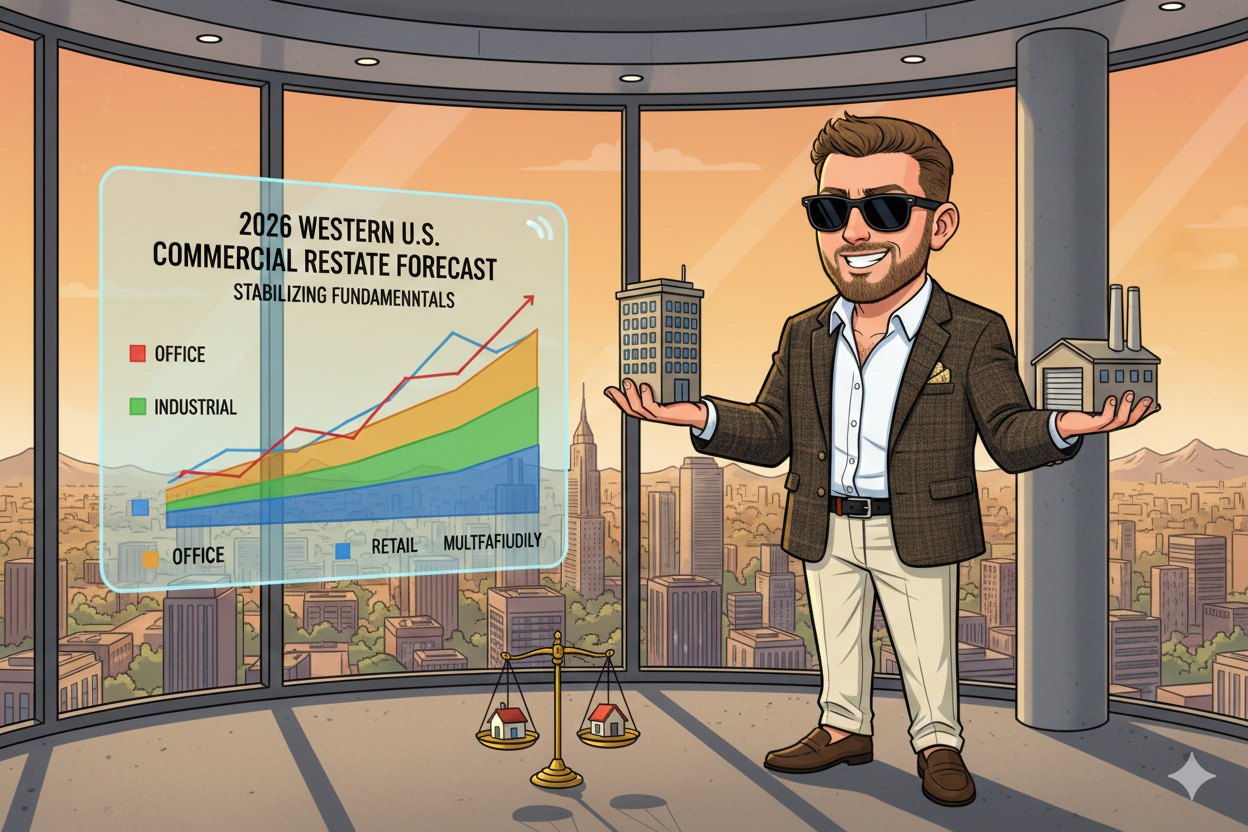
The commercial real estate landscape is entering a new phase in 2026, with market fundamentals showing signs of stabilization across key property types. According to the 2026 Western U.S. Market Forecast from Kidder Mathews, sectors such as office, industrial, retail, and multifamily are each evolving in unique ways as the broader economy transitions into a more balanced cycle. Understanding these trends is essential for investors, developers, property owners, and tenants navigating the next chapter of commercial real estate.
In this post, we break down the forecast and what it means for the future of commercial property throughout the Western U.S., from economic conditions to sector‑specific insights and where opportunities are emerging.
Economic Outlook: Solid but Selective Growth
The Western commercial market begins 2026 on relatively strong footing. The U.S. economy as a whole is supported by steady growth, moderating inflation, and resilient consumer demand, even as job growth shows signs of slowing. Investment in sectors like artificial intelligence and productivity‑enhancing technologies is expected to sustain economic activity and contribute to overall stability.
These macro trends suggest that the commercial real estate market is becoming less volatile and more predictable, an encouraging sign for long‑term planning and capital deployment.
Office Sector: A Slow but Improving Picture
After a challenging few years marked by evolving workplace habits and hybrid work models, the office market shows early signs of recovery in 2026.
- Leasing activity is strengthening in select markets.
- Vacancy and sublease space are beginning to trend downward.
- Limited new construction is helping rebalance supply and demand.
While the office sector still faces structural headwinds, particularly around older Class B and C office buildings, marquee properties in strong locations may benefit from renewed tenant interest. Investors and landlords who adapt spaces for flexibility and collaboration could see improved performance as the cycle progresses.
Industrial Sector: Balanced Fundamentals Ahead
Industrial real estate, encompassing warehouses, logistics space, and data centers, is moving toward a more balanced market in 2026.
- Steady leasing activity continues to support demand from logistics, e‑commerce, and data‑driven users.
- Stabilizing tenant demand suggests fundamentals are tightening after a period of cooling.
- A shrinking development pipeline helps reduce oversupply pressure.
This balance positions the industrial sector for sustained performance, making it a key asset class for investors seeking income and occupancy stability.
Retail Sector: Resilience in a Changing Environment
Retail continues to show resilient fundamentals heading into 2026:
- Limited new supply helps support low vacancy.
- Essential and value‑oriented retailers remain active, particularly in neighborhood and suburban centers.
- Foot traffic recovery is ongoing, and stable occupancy is expected to support measured rent growth across most formats.
Retail property performance may vary by location and tenant mix, but well‑positioned centers with strong anchors are likely to remain attractive to investors.
Multifamily Sector: Stability and Renter Demand
Multifamily remains an important part of the 2026 forecast, with fundamentals trending toward greater stability:
- Vacancy rates are stabilizing.
- New supply is moderating, easing concerns about oversaturation.
- Affordability challenges in the housing market continue to support renter demand.
These trends indicate that multifamily properties, especially those in high‑demand locations, can offer reliable occupancy and rent growth over time.
Key Takeaways for Commercial Investors & Developers
1. Stabilizing Fundamentals Across Sectors
While each commercial property type faces unique dynamics, indicators point to greater market balance in 2026 as leasing activity gains momentum and vacancy pressures ease in some sectors.
2. Sector‑Specific Opportunities
- Office: Adaptive reuse and flexible workspace design may unlock value.
- Industrial: Logistics and data‑oriented properties remain resilient.
- Retail: Neighborhood and essential tenant anchors perform well.
- Multifamily: Strong renter demand supports occupancy and rental stability.
3. Long‑Term Planning Is Key
Commercial real estate performance in 2026 won’t be uniform, success depends on location quality, asset type, tenant demand, and strategic positioning. Staying informed on market forecasts and fundamentals will help investors make smarter decisions.
A Balanced Outlook for 2026 Commercial Real Estate
The 2026 Western U.S. commercial real estate forecast reflects a market in transition, one that’s adjusting to economic realities while finding new areas of strength. Although challenges remain, especially around office space and shifting tenant needs, many sectors show resilience and opportunity.
By focusing on fundamentals, adapting to evolving demand, and investing with long‑term vision, commercial property owners and investors can position themselves for success in this next phase of the cycle.
|


or another way